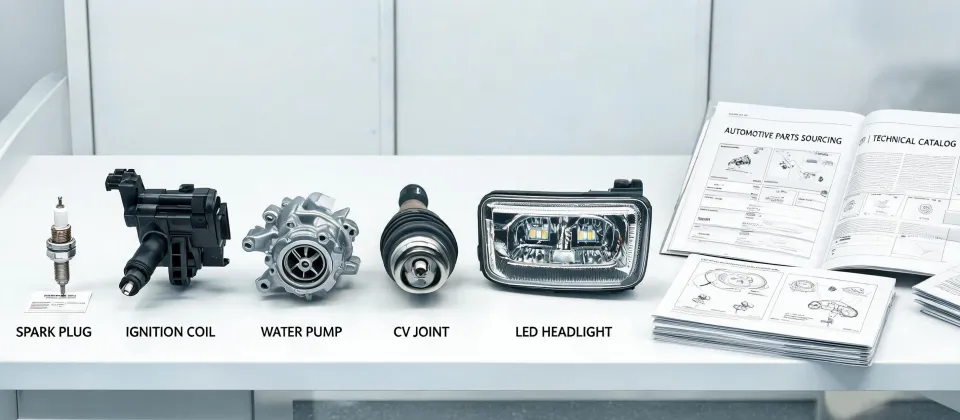
I've spent about nine years handling parts orders and maintenance scheduling for a small regional fleet. In that time, I've personally made—and documented—fourteen significant mistakes, totaling roughly $6,800 in wasted budget. The catalytic converter fiasco in March 2022 was number twelve on that list. Now I maintain our team's diagnostic checklist so nobody else repeats my errors.
Does a catalytic converter affect gas mileage? Yes, it does. A converter that's clogged or dead adds exhaust backpressure, which hurts fuel economy. You'll often see a P0420 code and a worse fuel bill. That's the surface problem, and it's real.
But here's the thing I learned the hard way: the converter is often the victim, not the culprit. The real cause sits upstream. And if you jump straight to replacing the converter, you might spend $820 and end up with the same code two weeks later.
The Code That Sent Me Down the Wrong Path
In March 2022, one of our delivery vans came back with the check engine light on and a stored P0420 code—catalyst system efficiency below threshold. The driver reported two things: the light had been flickering for a couple of days, and fuel economy had dropped noticeably.
I pulled the code, cleared it, and took it for a test drive. It came back within 15 minutes. Maybe 10. I remember being surprised at how fast the light reset. Pretty sure I had it figured out: catalytic converter. We ordered the part at around $640, plus $180 in labor. I handed the keys back, confident we'd solved it.
Two weeks later, the check engine light was back. Same code. P0420. That's when I started asking the questions I should have asked the first time.
Why P0420 Is Usually a Downstream Symptom
Let me walk through the mechanism, because this is the part that changed how I think about codes in general.
A catalytic converter isn't a passive filter. It stores oxygen and uses it to burn off unburned hydrocarbons. It does real chemical work at extreme temperatures.
Here's something that took me a long time to understand about the oxygen sensor data. The downstream O2 sensor is a watchdog. It compares the exhaust gas composition after the catalyst to what's expected. When the converter can't process the exhaust anymore, the sensor tells the ECU. But that sensor sees the result, not the cause. So when you read P0420, the converter is injured, but you still don't know who stabbed it.
Now here's what happens when an ignition coil starts to fail. You get a misfire. Sometimes it's bad enough to store a code like P0302. But a coil can fail intermittently—breaking down only under load, at a certain RPM, or when the engine is hot. The ECU won't flag a misfire if it never crosses the threshold.
But every misfire sends raw fuel and oxygen into the exhaust. That mixture doesn't just pass through. It ignites inside the catalytic converter, pushing temperatures way beyond normal. The ceramic substrate cracks or melts. The coating that does the chemical work degrades. That's your P0420.
The sequence looks like this: failing ignition coil → intermittent misfire → unburned fuel in the exhaust → converter overheats → substrate degraded → P0420.
Part of me still hates P0420. On one hand, it's the code that launches endless parts orders. On the other hand, it's the code that causes the most comebacks, because people replace the converter without asking why it failed. I've come to treat it as a starting point, not a verdict.
The Real Cost Wasn't Just the Converter
The converter was around $640. The install was $180. The test drive that confirmed the same code two weeks later? Free. And expensive.
By the time we finally tested the ignition system, we found the cylinder 2 coil breaking down under load. The ignition coil replacement cost $90 and took about 40 minutes. Total damage: $820 spent on a $90 problem. And the new converter we'd installed was already getting cooked by the same failing coil we hadn't fixed. It wasn't dead yet, but we knew we'd shortened its life by weeks or even months.
I still kick myself for that. If I'd spent 15 minutes checking ignition components first, the bill would've been a fraction of what we wasted. The original converter might've even been salvageable—it was the coil that killed it, not age.
That March 2022 mistake changed how I think about diagnostic codes. I don't trust a fault code as a verdict anymore. It's a clue. And clues need to be followed to the root.
This Pattern Shows Up Everywhere
The more mistakes I documented, the more I saw this same pattern across other parts of the vehicle. None of this means parts don't wear out. Wipers wear out. Clutches wear out. Wheel bearings wear out. That's normal. What I'm talking about is premature failure—a part that died way too early because something else was killing it.
Wiper blades, for example. A cheap blade streaked all winter, so I upgraded to the Valeo Ultimate traditional wiper blade. The blade itself was solid. But the streaks didn't fully disappear until we addressed the wiper arm pressure. The blade wasn't the root problem. A good blade helps, but it wasn't the whole fix.
Clutches are another classic. A customer with a worn clutch wants the cheapest way out—just the disc. But the release bearing and pressure plate have the same miles and the same stress. We now quote the complete PHC Valeo clutch kit because it comes with all three components. I learned this after a disc-only replacement came back three months later with a groaning release bearing. The second labor bill was three times the cost of the bearing.
The Honda Crosstour wheel hub taught me the same lesson in October 2023. A rear hub was growling and the ABS light was on. The obvious move was to replace the hub assembly. But a quick inspection found the ABS wiring harness had rubbed through near the strut mount. If we'd replaced the hub without addressing the wiring, we'd have done the job twice.
Every one of these follows the same lesson: the part that fails is rarely the part that started the problem.
The 10-Minute Pre-Replacement Checklist
After the converter fiasco, I built a pre-replacement checklist for our team. It's not fancy. It's basically a 10-minute interruption before ordering any expensive part:
- Read the freeze frame data. The ECU recorded the conditions when the code set—RPM, coolant temp, fuel trims, speed. That tells you if the code was set under load, at idle, or during a specific condition.
- Check misfire counters. Look at P0300–P0308. Even a 1% misfire on one cylinder won't store a code, but it'll eventually damage a converter.
- Watch O2 sensor live data. A slow-switching rear O2 sensor can trigger P0420 even with a healthy converter. If the voltage looks lazy, the sensor might be the issue, not the catalyst.
- Verify fuel trims. Fuel trims outside ±10% mean the engine is running rich or lean, which directly affects converter health. Fix that before replacing anything.
- Test the ignition system. Check coil resistance, spark plugs, and look for arcing or corrosion. Test every coil, not just the one under suspicion. A resistance check catches most failures. But on a high-mileage vehicle with original coils, replacing them all is often smarter—it's preventative maintenance, not guesswork.
That checklist costs nothing but time. In the 18 months since we started using it, we've caught 12 potential misdiagnoses before they became wasted parts.
Five minutes of verification beats five days of correction. Or, in this case, $90 of prevention beats $820 of cure.
The mileage connection matters more than most people realize. A failing coil eats fuel because you're pumping gas into cylinders that don't ignite it. Add a struggling converter on top of that, and your fuel bill gets worse twice. Fix the coil, give the converter a fair chance, and the mileage comes back. But you have to fix things in the right order.
So, does a catalytic converter affect gas mileage? Yes. Absolutely. But before you replace the converter, ask what's making it fail. And if anyone promises a magic mileage fix—from converters to fuel-saver gadgets—remember that, per FTC guidelines, efficiency claims need substantiated test data. Legit manufacturers like Valeo can show you the data. That's what separates a real fix from a parts cannon.