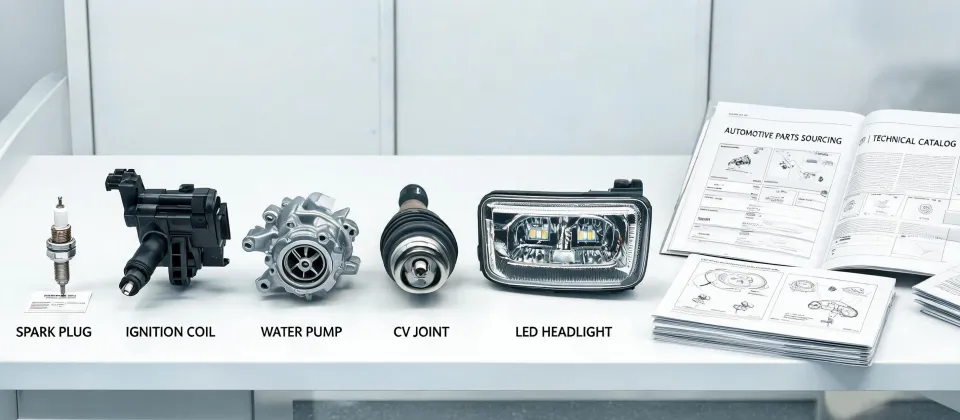
I'm a quality and compliance manager at Valeo. I review every part before it reaches customers—roughly 2,000 unique part numbers a year. In Q1 2024, I rejected 11% of first-article samples because of tolerance mismatches or missing material certifications. I say that not to sound tough. I say it because the most common question I get from DIYers and shop owners is the same: 'Why did this part look right but fail so fast?'
The Surface Problem: Parts That Look Fine but Definitely Aren't
From the outside, buying a cheap auto part looks like the same part with a lower price. The reality is a little more complicated. Most quality issues aren't visible in a photo or at the counter. A machined bracket can look perfect and still be 0.2 mm off on the mounting face. That 0.2 mm might not stop the bolt from threading, but it can misalign a belt, put load on a bearing, and turn a $60 part into a $400 repair.
This is where the 'nobody gets fired for buying cheap' logic falls apart. We're not talking about cosmetics. We're talking about the interface between components. On a modern vehicle, tolerances are tighter than they've ever been. The engine computer watches things like knock, airflow, and alternator output. A small variation that once might have been harmless now triggers a code or a limp mode.
When someone searches for a single spark plug wire, they usually think they're buying a wire. But a single spark plug wire has specific resistance, inductance, and terminal angles. I've seen wires pass a visual inspection and then cause a misfire because the boot didn't seal. The wire looked identical to the original. It wasn't. That's the surface problem: the failure isn't in the visible part, it's in the specs you can't see.
Why 'OEM Compatible' Doesn't Mean 'OEM Quality'
This is probably the deepest misunderstanding in the aftermarket. 'Compatible' means it fits in the same location. It doesn't mean it behaves the same. Take the 2013 Kia Soul alternator. I've had a vendor ship a 'direct replacement' with the same mounting bracket and electrical connections. The alternator fit. It charged. But the pulley ratio was slightly different, so at idle the belt speed was different enough to cause a low-voltage condition under load. In my book, that's not a replacement.
The same thing happens with AC compressors. Genuine Valeo AC compressor parts aren't just a bunch of metal and seals. The internal clearances are set to a controlled spec. An 'AC compressor replacement' from an unlisted wholesale warehouse can have the same bolt pattern but a different internal displacement or valve timing. It'll probably keep an old car alive through a hot summer—until the evaporator freezes or the compressor seizes at 70 mph. The worst part is you won't know which until you've already paid labor and refrigerant.
Let me be clear about 'Valeo wholesale auto parts warehouse.' There are legitimate wholesale warehouses that stock genuine parts. There are also websites that use part numbers and brand names to make a listing look legitimate. The phrase 'looks like Valeo' is not a quality standard. If the listing doesn't include a known part number, a spec sheet, or a supplier name you can verify, that's a red flag.
The Real Price of a Bad Part
Now comes the part that usually gets ignored. If a $90 alternator fails after eight months, what did it really cost? You have the $90, the shop labor to install it, the tow if you were stranded, and the rental car or lost work. On a 2013 Kia Soul, you might get two and a half hours of labor for the alternator. Even at $100 an hour, that's $250. Add the tow, the diagnostic charge, and the fact that the part is still under warranty but the labor isn't, and the 'cheap' part just cost you around $500.
That's why my team tracks first-pass yield and warranty return rates, not just piece price. It's the same logic that should drive a repair decision. I'd rather install a part with a slightly higher piece price and a dependable spec than deal with one comeback that wipes out the profit from ten jobs.
Quality issues also have quiet costs. If you buy a part for a customer and it fails, you don't just lose labor. You lose trust. The shop owner remembers the wasted Saturday. The customer remembers that you said 'it'll be fine.' Nobody computes the exact number, but they all make a decision on the next job.
After the third failed alternator in the same model, I was ready to throw the spec sheet at the wall. It wasn't the alternator itself—it was the way the 'same' part had been produced by three different suppliers. That experience changed how I look at a part number.
Brand names and part numbers aren't enough. You need to know who actually made the part and to what standard.
What Actually Helps (Not a Long Sales Pitch)
Here's what I tell anyone who asks. I'm not going to tell you to buy the most expensive part you can find. I'm going to tell you to buy from a source that can prove what you're getting.
First, look for a spec sheet. If you're buying an AC compressor, find the exact displacement, oil type, and tolerances. If the seller can't provide that in two clicks, that's the market telling you something.
Second, verify the brand trail. With genuine Valeo parts, you have a known set of specifications and traceability. With 'Valeo compatible' or generic wholesale inventory, you don't. That uncertainty matters, especially for internal engine or transmission parts where failure is expensive.
Third, understand the difference between 'in stock' and 'in production.' A wholesale warehouse might have a part on the shelf from a job lot. That doesn't mean it was made to the same quality standard. When I order components for our own manufacturing line, I require material certs and dimensional reports on every lot. An individual buyer can't demand those on a retail order, but you can at least buy from a seller that publishes them.
To be fair, there are cases where a no-name part is fine. A bracket? Maybe. A door sensor? Probably. But a single spark plug wire, an alternator, a muffler delete and straight pipe—these interact with heat, vibration, and engine management. The cost of guessing is too high.
If you're asking 'how much is a muffler delete and straight pipe,' you're probably expecting a simple price. The truth is that the price depends on who's doing the math. A cheap shop might delete the muffler and leave the exhaust with a drone at highway speed. A better shop accounts for pipe diameter, hangers, sound testing, and maybe an O2 sensor relocation. From my side of the industry, this is exactly why I support customer education. You don't need to be an engineer. You just need to know which questions to ask.
An informed customer asks better questions, and a better question is worth more than a discount. I'd rather spend ten minutes explaining what makes a part reliable than deal with a mismatched expectation later. If you know what you're buying, you'll make fewer return trips, lose less labor, and maybe, just maybe, avoid the most expensive part in the world: the cheap one.