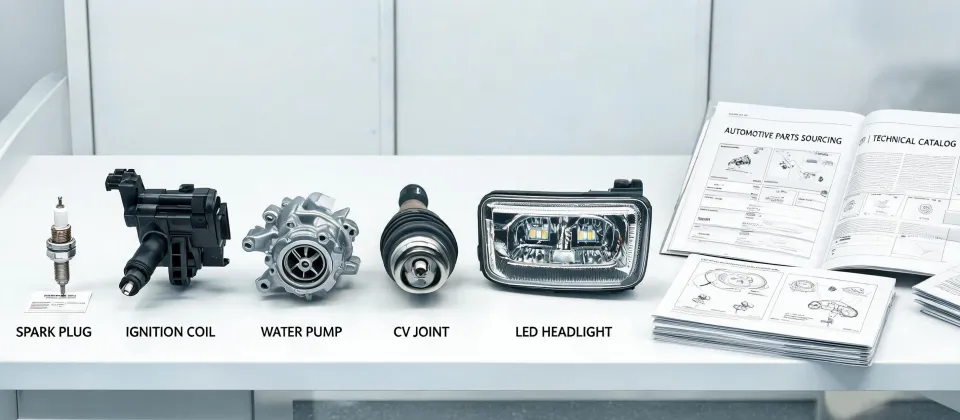
If you've ever opened the Valeo catalogue—or spent an evening digging through the Valeo products catalog—you were probably doing the same thing I do almost daily: trying to confirm that the part will fit and actually fix the problem. That's the surface question. The deeper question is why the original part failed in the first place.
I'm a quality inspector at an automotive parts company. I review 200+ unique replacement parts every year. In 2024 I rejected 7% of first delivery lots for fit, finish, or documentation issues. I'm not an engineer, so I'm not going to lecture you on combustion chemistry or bearing metallurgy. What I can do is tell you what the part number won't tell you.
The Parts People Search For
What's an O2 Sensor?
An O2 sensor, often called a lambda sensor in Europe, is a small probe mounted in the exhaust stream. It measures the amount of oxygen left after combustion and sends a voltage signal to the engine control unit. The ECU uses that signal to correct the air/fuel ratio. If the sensor is dead or sluggish, the engine can run rich or lean. You may see worse fuel economy, a failed emissions test, or a check engine light with fuel trim codes. But here's what I want you to keep in mind: the sensor is a messenger. It reports what's happening in the exhaust, even if the problem is somewhere else. If you're replacing an O2 sensor because of a code, that's a reasonable starting point. Just don't assume the diagnosis ends there.
What Is a Resonator Pipe?
A resonator pipe is an exhaust component designed to cancel out specific sound frequencies. It looks sort of like a muffler, but it's not there to silence the whole system. It's there to remove drone at a certain RPM or to shape the exhaust note. Because the shape and internal volume matter, a close-enough resonator is not close enough. I've rejected pipes where the hangers were a centimeter off. They would bolt up, sure, but they would sit a few millimeters from the heat shield. You don't need to be an engineer to see why that's a bad idea. A resonator is easy to underestimate until you hear the result.
What Happens if Wheel Bearing Goes Out?
If you've ever searched that phrase, you probably have a noise you're trying to identify. A failing wheel bearing usually starts as a grinding, rumbling, or humming sound that changes with speed. It often gets louder when you steer one direction. As it gets worse, the wheel can develop looseness, tire wear becomes uneven, and the ABS may act up because the sensor ring wobbles. In severe cases, the bearing generates enough heat and play for the wheel assembly to fail. That can mean the wheel locking up or separating from the car. That's not a scare story. A wheel bearing is a safety-critical part. If you hear that noise while driving, don't turn up the radio and hope it goes away. That noise is a clue.
The Deeper Problem Is Usually Not the Part
Here's where I'd challenge most part replacement logic. The O2 sensor, resonator pipe, or wheel bearing in the catalogue is rarely the whole story. The repeat failure you're trying to avoid is usually caused by contamination, installation error, or an upstream fault. The part number tells you what should fit, not why the old one failed. That second part is where most warranty returns and repeat repairs come from.
For example, I've seen a customer return an O2 sensor after three weeks. The element was covered with oil residue. The sensor worked. The engine had a leak. A new sensor just meant a new target. Same with wheel bearings. I assumed early in my career that wheel bearings fail because they're old. Not true. Many premature failures come from wrong torque, debris during installation, or a damaged ABS tone ring. A bearing can pass a bench test and still be doomed by the hub condition.
Resonator pipes are a little different. The complaint is often sound, but the sound is a symptom. A low rumble can be an exhaust leak, a misfire, a worn hanger, or a broken internal baffle. If you replace the pipe without fixing the root cause, the drone might only get slightly better. And a generic resonator is not a substitute for the tuned original. The internal chamber is the part. The dimensions that look like millimeters on a drawing can be the difference between a quiet highway and an annoying drone.
What That Costs You in Time, Money, and Risk
Let's talk about real costs. The O2 sensor return I mentioned ended up costing the customer more than the sensor itself. They paid for a second diagnostic visit, labor, return shipping, and the hours the car sat in the shop. What looked like a $120 sensor problem became a much bigger invoice. I don't know the exact number, and it depends on the shop, but the expensive part was not the sensor. It was the wasted work.
With wheel bearings, the cost of waiting is even bigger. Drive on a failing bearing long enough and the heat and debris can damage the hub, rotor, and wheel speed sensor. What could have been a one-hour bearing job turns into a hub and brake job. I've seen estimates in the $250-$500 range for a single wheel, but that was before recent price changes. Take that with a grain of salt. The point is that ignoring the noise always reaches a point where the fix costs more. If you wait until something fails completely, you're not just buying a bearing anymore.
Resonator pipes are less dramatic but still annoying. If you buy the wrong one, you're dropping the exhaust twice, buying new gaskets, and possibly fighting a new rattle. A $100 pipe can easily become a $500 afternoon. In my opinion, the cheapest part in the catalogue gets expensive the moment you have to install it twice.
How I Use the Valeo Catalogue Today
Here's what changed my own process. I stopped treating the catalogue as a yes-or-no fitment tool and started treating it as a spec sheet. To be fair, the catalogue is not useless—it's a huge help. It just doesn't carry the whole diagnostic load. The Valeo products catalog contains cross-references, connector notes, dimensions, and supersession information. Use that.
- Search by full part number and cross-reference it to the OEM part number. Fits 2018-2022 is not enough in my book.
- For O2 sensors, check the connector shape, number of wires, and whether the part is wideband. Two sensors can look the same but communicate differently.
- For resonator pipes, compare body length, inlet/outlet diameter, and hanger positions. If any of those are off, the sound and the fit will be off.
- For wheel bearings, match the ABS ring, number of studs, and seal count. A bearing with the same diameter but the wrong ABS ring will set a code.
- Ask about supersession and returns before you order. A transparent supplier will tell you if a part has been revised. One who says it's fine without checking is telling you something.
From my side of the desk, I've learned to ask what's NOT included before asking what's the price. The supplier who lists everything upfront—even if the total looks higher—usually costs less in the long run. That's true for parts, and it's true for repairs.
The part is the start of the repair, not the final proof.
This gets into exhaust tuning and bearing load territory, which isn't my expertise. If you're designing a custom resonator or calculating a bearing load, talk to an engineer. From a quality standpoint, repeat failures are almost never solved by replacing the same part with an identical copy. You have to fix the condition that killed the first one.
One final note: this was accurate as of my Q4 2024 audits and early 2025 catalogue checks. Vehicle platforms change, sensors get revised, and part numbers get superseded. Verify current Valeo catalogue information before you buy. A seemingly identical part can have a different connector or calibration in a newer revision.