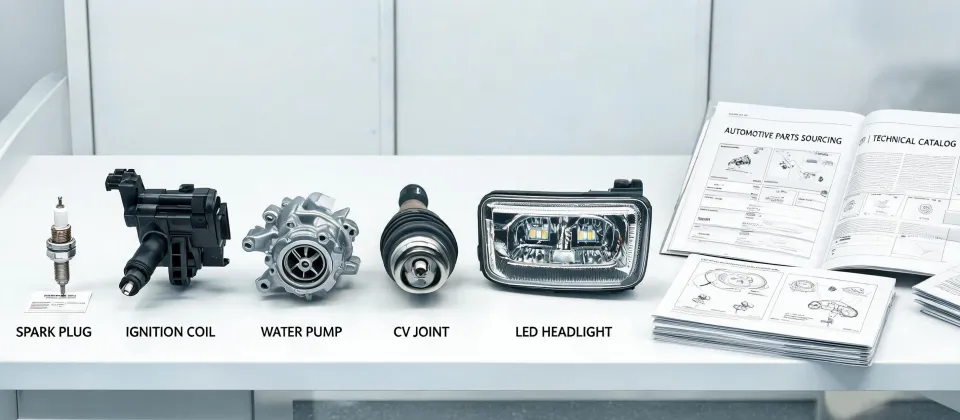
Check engine light on. Alternator warning at a stoplight. A slight shudder when you let out the clutch. Three browser tabs open, and you already know what you're going to buy.
You searched for valeo oe flywheel because that's the part that keeps coming up for your car. You looked at valeo alternator brushes because a $25 brush set beats a $500 alternator. You searched fuel filter autozone and added the first result to your cart. You pulled up a headlight color chart and picked a 'cooler' bulb. And you've got one of the best throttle body cleaners in your cart because the idle has been rough for a week.
Here's what nobody wants to hear: none of those parts may be your problem.
I've worked at an automotive parts manufacturer for eight years. My job is less glamorous than it sounds. I review returned parts, audit warranty claims, and maintain a mistake checklist so the same failure doesn't happen twice. I've personally documented 31 product failures worth roughly $47,000 in scrap, rework, and wasted labor. I've also caused two of them myself and approved a third one that still embarrasses me.
The surface problem: 'The new part didn't fix it.'
When a replacement part doesn't fix the symptom, the automatic assumption is that the part is junk. Sometimes it is. But after reviewing 31 failures, the pattern is uncomfortable: a bad specification causes more failures than a bad part.
People buy the right category of part. They buy the wrong specific version. The search results said 'compatible.' Nobody checked the engineering specification underneath.
What most people don't realize is that 'fits' in a parts catalog means mounting points and connectors line up. It does not mean the internal specs were validated for that vehicle. You can bolt on a part with the same threads, same connectors, and same visual shape—and still be 20 percent off on the parameter that kills it.
Five parts, one root cause
1. The Valeo OE flywheel that wasn't
Flywheels aren't just heavy disks. They store rotational inertia. The engine management system, clutch, and transmission are all tuned to a specific flywheel mass and balance. A genuine Valeo OE flywheel is built to match the original engine's torsional vibration calculations. That's why the OE part has a balance specification, not just a 'direct replacement' promise.
In 2022, a customer replaced two dual-mass flywheels and a clutch kit before someone looked closer. The 'compatible' flywheel had the right bolt pattern, but the moment of inertia was 11 percent lower than the original part. At idle, no problem. At 3,000 rpm, the gearbox sounded like a bag of spanners being shaken. The flywheel wasn't defective. It was wrong for that engine.
2. Alternator brushes: the $14 part that can kill an alternator
Alternator brushes are one of the smallest parts in a car, and one of the best examples of why 'looks the same' doesn't matter. Valeo alternator brushes use a specific graphite grade and spring pressure matched to the commutator material in that alternator. A $12 generic brush may fit in the holder. But if the graphite is too hard, it polishes the commutator unevenly. If it's too soft, the carbon dust shortens bearing life.
I once had a supplier offer a 'better' brush compound that was 20 percent cheaper. The saving on a 5,000-piece order was $1,400. The risk was a 500-hour bench test showing 30 percent more commutator wear. The upside didn't justify it. We declined, and then I second-guessed the decision for two weeks. The test report said we were right, but the doubt was real.
3. The fuel filter from AutoZone isn't the problem
Searching for fuel filter AutoZone isn't wrong. Parts stores sell good filters. The problem is that a fuel filter has to do more than fit the line. It has to handle the system pressure, flow rate, and filtration efficiency.
Modern direct-injection systems use much tighter filter ratings than older port-injection or carbureted systems. Per ISO 19438, fuel filters are rated by particle retention and contaminant capacity. A filter that fits both a 1997 truck and a 2023 truck can be the same physical size but rated for a low-pressure system. Under high-pressure pump suction, that filter can collapse internally.
The 'change it every 10,000 miles' habit came from the carburetor era, when a fuel filter was basically a strainer. Today, the right interval is whatever the vehicle manufacturer spec says. The filter isn't just dirt protection; it's part of the fuel delivery design.
4. The headlight color chart is a trap
I understand the appeal of the headlight color chart. 6000K looks modern. 4300K looks factory. 3000K looks yellow. But color temperature is only one number in lighting design. Luminous flux, beam pattern, and housing compatibility matter just as much.
Per FMVSS 108 (49 CFR § 571.108), replacement headlamps must meet the same beam pattern requirements as the original lights. A bulb that looks blue in a reflector housing can create glare and fail inspection, even when the color chart says it's 'ice blue.' In one of my own cars, a 6000K LED kit threw a hotspot that looked great from the driver's seat and terrible 200 feet in front of the car. The chart didn't tell me that.
5. The best throttle body cleaner won't fix a bad diagnosis
A dirty throttle body can cause a rough idle. So can a dirty MAF sensor, a cracked vacuum line, or a failing EGR valve. Search for best throttle body cleaners and you'll find hundreds of testimonials that assume the answer is carbon removal. But the cleaner is only a tool. The best cleaner in the world won't fix a leak.
I've also seen the cleaner make things worse. It stripped a dry-film coating from a newer throttle plate, and the idle hunting got worse than before. The product wasn't bad. It was used on the wrong part.
The cost of chasing the wrong spec
Let me put this in numbers from my checklist:
- 31 documented mistakes, with a total cost of roughly $47,000.
- 21 of those 31 mistakes came from choosing 'compatible' instead of verifying the OE spec.
- The flywheel batch I approved: 240 units with unacceptable vibration, $12,600 in rework, and a week of lost production.
The money is bad, but the bigger cost is confusion. A wrong flywheel doesn't fail immediately. It vibrates, kills a clutch, and makes the technician suspect the entire engine. Wrong brushes don't fail in the first mile. They wear the commutator, and the alternator dies at mile 9,000. A wrong fuel filter doesn't throw a code. It collapses, and the fuel pump fails. The repair gets bigger, and the customer loses trust.
Here's something vendors won't tell you: 'OEM quality' is not a certification. It's a phrase. The actual OE part is built to the original drawing and validated with the same tests as the production part. 'OEM quality' is whatever the aftermarket manufacturer decided to call it. That difference matters even for small parts. A Valeo brush set costs a fraction of an alternator, but the graphite grade is matched to that alternator's slip rings. The 'compatible' one might fit, spark less, and still score the ring in 8,000 miles.
The fix: a five-question checklist
After the flywheel incident, I built a pre-install checklist for every part sample. It's not long. Five questions:
- What was the original part number on the vehicle? (Not the aftermarket reference.)
- What are the controlling specifications? (Weight, pressure, flow rate, material grade, balance tolerance.)
- Do I have a test report or certificate? (Balance sheet, flow curve, bench test data.)
- Have I compared the physical sample to the OE sample? (Not just a photo in a listing.)
- Have I checked the installation conditions? (Housing depth, connector orientation, access for tools.)
The checklist doesn't take an hour. It takes five minutes. But in the 18 months since I added it, we've caught 47 potential errors before they shipped. 47 mistakes that never reached a customer. I also made the checklist digital and built it into the workflow instead of leaving it as a separate step. That cut our turnaround from 5 days to 2 days because we stopped hunting for paper files. Verification isn't a tax on speed. It's what makes speed possible.
So next time you're staring at the headlight color chart or comparing best throttle body cleaners, pause. The part probably isn't the problem. The missing spec is. Fix that, and the part will behave.