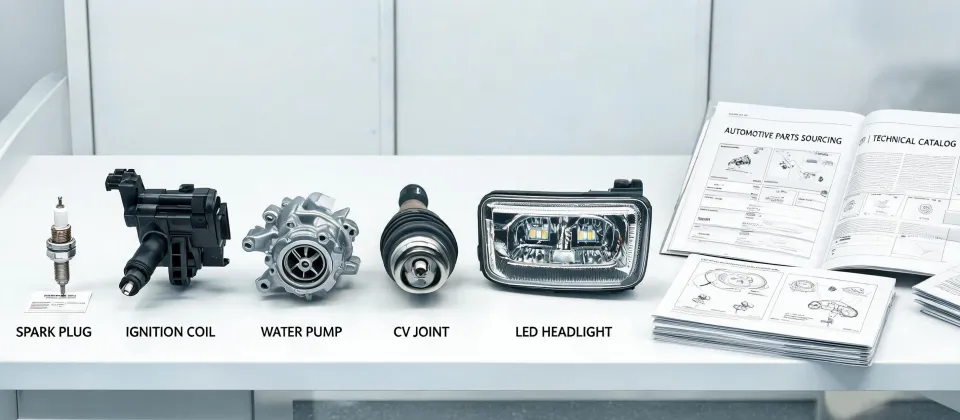
I'm an aftermarket parts specialist handling replacement parts orders for a mid-sized service center and a small fleet. I've been doing this for eight years. I've personally made (and documented) 14 significant ordering mistakes—maybe 16, I'd have to check the spreadsheet—totaling roughly $6,800 in wasted budget. Now I maintain our team's checklist so the next person doesn't make the same calls.
When people ask me what to buy, the honest answer is: it depends. There's no universal "best part" that works for every vehicle or every symptom. This article is arranged the same way I'd talk through a parts order: here are the common scenarios, what I'd look for in each, and how to tell which one you're in. If you've searched for a Valeo product on the Valeo homepage and still ended up uncertain, you're in the right place.
Scenario 1: Do You Actually Need a Valeo Silencio Wiper Blade Set?
This is the most common request on our counter, and it's often not a parts issue. If your wipers are leaving streaks, first clean the windshield and wipe the rubber edge with a soft cloth. I've fixed a lot of "bad wipers" with a clean glass surface. But if the edge is cracked, stiff, or torn, they need replacement.
When I order wipers for street vehicles, the Valeo Silencio wiper blade set is the one I grab first. It's a quiet, low-profile blade that fits a wide range of cars, which makes it practical for a shop that doesn't want to stock 50 different SKUs. The "Silencio" name isn't just marketing; the design is meant to reduce wind lift and noise at highway speed.
Here's the mistake that ended up on my checklist: blade length is not the only spec. The connector has to match your wiper arm. I once ordered 12 blades with the wrong hook adapter and returned 11 of them. That was a $450 mistake, plus the week of waiting. The Valeo homepage has a fitment finder; use it. What I mean is, don't rely on a photo in a search result. Check the vehicle model, year, and arm type before checkout.
The counterintuitive part: a premium blade isn't always better. A correct-fitting mid-range blade will outperform a high-end blade that's the wrong size. Price matters less than fitment.
Scenario 2: "Alternator, What Does It Do?"—and When to Replace It
This is the question I hear whenever a battery light comes on. In plain language, the alternator is a small generator driven by the serpentine belt. It charges the battery while the engine is running and powers the electrical system. The battery gives the cranking power to start the engine; the alternator keeps the car running once it's going.
But "it charges the battery" doesn't automatically mean "replace it." I learned this after the alternator misdiagnosis in March 2023. We swapped a battery, then a starter, and finally checked charging voltage. It was the alternator the whole time. That error cost us two days and some trust with the customer.
Before ordering a new one, do a simple voltage test. Engine off, a healthy battery reads around 12.6 volts. Engine running, it should rise to roughly 13.5–14.5 volts. According to ASE training materials, that's the range a properly working voltage regulator should hold. If the voltage stays low once the engine starts, the alternator is likely the problem.
Now the piece people don't expect: a higher-output alternator is usually not an upgrade. If the vehicle was built for a 120-amp unit, bolting in a 200-amp unit doesn't "help it run smoother." It can overstress the belt and confuse the charging system. Match the original equipment spec, unless you've added winches, high-power audio, or other serious electric loads that require more current. (Surprise, surprise: the customer who wanted the biggest alternator we had came back with an overcharged battery.)
Scenario 3: The Golf Cart Spark Plug Trap
A golf cart may look simple, but a golf cart spark plug is not just a miniature car spark plug. The thread reach, heat range, and gap are specific to the engine. Put the wrong one in and the cart might start, but it may run rough, misfire, or overheat.
I don't have hard data on how many returns in this category come from using the wrong search term, but based on our returns shelf, my sense is it's a lot. People search "golf cart spark plug" and grab the first result that says universal. Then they're surprised when the gap is 0.010 inch off and the cart won't run right.
Find the engine model number first. It's usually stamped on the valve cover or listed in the owner's manual. Then search by that engine model. The gap spec might be in the ballpark of 0.028–0.032 inches, but your cart's spec is what matters, not a ballpark. If you buy a plug that's close but not gapped correctly, adjust it with a gap tool before installation. Better yet, order the exact plug from an engine parts list, not a generic automotive site.
This process works for a single cart or a small fleet. If you're a dealer ordering for dozens of carts, the process should be more formal: get a cross-reference list from the engine manufacturer or a supplier who handles small engines.
Scenario 4: Searching "Water Balloons Pump" Instead of the Part Name
This is about search behavior, not product quality. It's also the source of the phrase "water-balloon-pump moment" around our shop.
In June 2022, someone on our team typed "water balloons pump" into a parts catalog search, looking for a water pump for a customer's coolant leak. The results were party supplies, which was exactly the wrong pump. (To be honest, it took us a minute to stop laughing and search for "engine water pump" instead.) That mistake cost an hour and a lot of jokes, but it's a perfect example of why the part name matters more than the sales site's search bar.
If you're not sure what the part is called, start with an OEM parts diagram or a manufacturer like Valeo. The Valeo homepage has clear product categories, so you don't need to guess. For charging system questions, searching "alternator what does it do" is a good explanation starter—but once you know the part, verify the exact spec for your vehicle before ordering.
A wrong part doesn't just cost the part price. It costs way more than the part price: downtime, shipping, and patience. We've caught 47 potential order errors in the past 18 months by double-checking the part name, the fitment, and the vehicle model before hitting submit. That checklist is boring, and that's exactly why it works.
How to Tell Which Scenario You're In
Here's the decision check I run for every order, including my own:
- Name the symptom first. Streaking windshield? Wiper area. Flashing battery light? Charging system. Rough-running golf cart? Spark plug or fuel issue. Search results that look like a party store? Search-term issue.
- Check fitment before you check price. Use the Valeo homepage, an OEM diagram, or your owner's manual. If the search result doesn't list your exact model, it's a red flag, not a suggestion.
- Ask if your situation is normal. A stock daily driver usually wants OEM-spec parts—that part is often a no-brainer, assuming fitment checks out. A modified vehicle, a commercial fleet, or a bulk buyer needs more verification before ordering hundreds of units.
This approach works for us, but our situation is a mid-size service center with walk-in customers and a few fleet accounts. If you're an OEM or Tier 1 supplier ordering components in large volumes, the calculus is different: engineering drawings and sample approvals matter more than a personal checklist. The principle is the same, though: don't let a search box do your thinking for you.
I'd rather answer a "basic" question at 8 in the morning than process the return two weeks later. An educated customer is not a bad customer; they're the one who asks the right questions and makes the decision easier. If you need help narrowing down the exact part for your vehicle, take the extra ten minutes to look it up. It's cheaper than the $6,800 education I got.
Bottom line: no single part is right for every car, but the search process should be consistent every time. Know the symptom, know the part name, verify the fitment, and then order.