-
Valeo Windshield Wipers Reviews: The Bench-Level Comparison
-
Valeo Windshield Wiper vs. Budget Blade: Contact Is the Real Test
-
Valeo Headlight Assembly vs. Cheap Replacement: Water Is the Failure Mode
-
Honda Element Oil Filter vs. Generic Filter: Same Thread, Different Spec
-
The Best Air Filter for Furnace: MERV Is a Spec, Not a Marketing Number
-
Differential Repair Service Phoenix: Case Study in Total Cost
-
Which Should You Choose? Apply the Second-Purchase Test
Valeo Windshield Wipers Reviews: The Bench-Level Comparison
If you are reading Valeo windshield wipers reviews, you probably want to know whether the blade will do its job without drama. I read reviews the same way I read supplier certificates: useful, but not enough. I am a quality and compliance manager at an automotive component company. Every month I review roughly 200 unique part numbers before they move forward. Last year, I rejected about nine percent of first deliveries because the part on the bench did not match the part in the drawing.
The comparison I want to run here is not a brand-versus-brand fight. It is a total-cost comparison: OE-grade component vs. the cheapest compatible part that fits the same application. I use the same checklist for a wiper blade, a headlight housing, an oil filter, and even a furnace filter. If the part fails, what is the second purchase?
When I first started in quality, I thought a cheaper part was simply a better use of budget if it measured the same. The measurement told only half the story. I still kick myself for approving a price-driven supply switch on a coated steel component because the customer needed parts that week. We saved $0.41 per unit and spent about $22,000 on rework after the coating started lifting. That is the day I stopped treating unit price as the real price.
Total cost = unit price + labor to install + risk of premature failure + cost of the second repair.
The rest of this article is a comparison across five product examples. Some of the conclusions are uncomfortable: the cheap part is sometimes perfectly rational. But that decision has to be made with the total-cost formula, not with a price tag.
Valeo Windshield Wiper vs. Budget Blade: Contact Is the Real Test
Most Valeo windshield wipers reviews describe an easy installation and a clean first swipe. Those are good signs, but they do not tell you what happens at highway speed in heavy rain. A wiper blade has to keep a continuous contact patch on a curved windshield while arm pressure changes. That is why I inspect the rubber edge before installation and the wipe pattern after installation.
A low-cost blade can look identical in a product listing. On the bench, I check three things: the edge cut, the surface coating, and the beam tension. I have tested budget blades where the coating started to wear unevenly after several weeks. That is not universal, but it is common enough that I stopped treating wiper blades as a commodity.
I don't have hard data on how many no-name blades fail in the first ninety days. Based on the samples I have examined, the failure is often uneven wear, not sudden breakage. The blade gets noisy, leaves a thin film, and the driver turns the wipers off because the noise is worse than the rain. The right blade avoids that sequence. At least, that has been my experience with the OE-grade units I have reviewed.
Verdict: If you replace wipers twice a year and drive mostly in light rain, the budget blade may be acceptable. If you drive highway miles and rely on wipers in storms, buy the OE-grade blade. The extra cost is small next to the cost of impaired visibility.
Valeo Headlight Assembly vs. Cheap Replacement: Water Is the Failure Mode
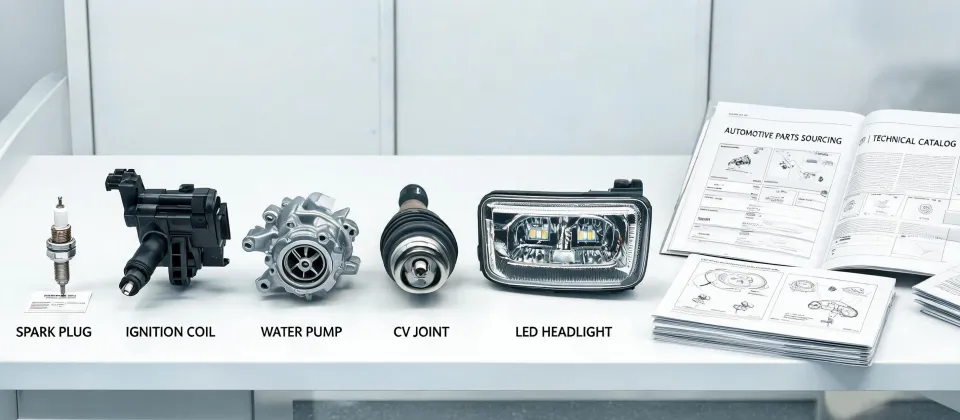
The same logic appears when someone asks me whether a cheap replacement headlight is good enough. A Valeo headlight assembly is designed as a system: lens, reflector, housing, vent, and connector socket. The cheap replacement may bolt up fine. The issue is usually not the first week. It is the first rainstorm.
I wish I had photographed a budget headlight housing I inspected two years ago. The vent was almost blocked by mold flash, and moisture appeared inside the lens after a basic water test. I don't remember the exact model, so don't quote me on the part number, but the lesson stayed with me: the lens can look clear while the housing is already compromising the optics.
A foggy lens does not just look bad. Water droplets scatter the light, and scattered light makes night driving harder. That failure mode turns a low-cost housing into a second parts purchase plus labor.
Verdict: For a part that affects night visibility, choose the design, not just the shape. Check that the replacement has a working vent and a sealed connector area. If you see condensation inside during the return period, return it. Don't try to patch it.
Honda Element Oil Filter vs. Generic Filter: Same Thread, Different Spec
Filters are the easiest place to make the total-cost argument. A filter looks like a simple shape. If it fits, it should be fine. In reality, a filter is a safety device for the system it protects.
The Honda Element oil filter has to meet a specific bypass valve calibration and it also needs an anti-drainback valve. The bypass valve controls what happens when oil is thick on a cold start or when the filter is reaching the end of its service life. The anti-drainback valve keeps oil in the filter after shutdown. A filter with the same thread but the wrong internal calibration can still screw on and still look normal while doing its job differently.
I don't want to claim every generic filter is dangerous. Some are perfectly fine. But the oil filter is a small part with a large job, and the price gap between a spec-correct filter and a mystery-brand filter is usually small. If the filter is the only thing protecting the engine from a dry start, don't make the engine the test lab.
Verdict: Choose the Honda Element oil filter that matches the OE specification. You are not paying for a logo. You are paying for calibration, materials, and quality control.
The Best Air Filter for Furnace: MERV Is a Spec, Not a Marketing Number
If automotive examples are not enough, the same mistake happens at home. Some shoppers search for the best air filter for furnace and assume that a higher MERV number is always better. MERV stands for Minimum Efficiency Reporting Value, and it is measured under ASHRAE Standard 52.2. The right MERV depends on the equipment, the duct system, and the filter slot.
In one house, a MERV 13 filter improves air quality and works fine. In another, the blower has to fight against a dense filter, airflow drops, and the furnace runs with a higher temperature rise than the manufacturer intended. The expensive filter is not the one with the highest number. The expensive filter is the one still installed three months after it should have been changed.
Verdict: The best air filter for furnace operation matches the system, is installed in the correct direction, and is changed on a schedule. If a filter restricts airflow enough to affect the equipment, the 'better' filter just became a more expensive failure.
Differential Repair Service Phoenix: Case Study in Total Cost
The total-cost rule gets clearer when labor costs more than the part. I have seen this through a differential repair service in Phoenix. The shop had two rebuild options on the bench: a kit with traceable bearings and seals, and a blank-box economy kit. The price difference was about $120, if I remember correctly. The labor to install either kit was the same.
If a differential bearing fails at 8,000 miles, the repair does not cost what the first repair cost. It costs more: towing, rental, shop labor, and a second set of parts. In Phoenix, heat and dust make lubrication failures less forgiving. That is why the shop owner told the customer to compare the second repair cost, not the kit price.
I am not saying every shop should use the most expensive kit in every job. I am saying the decision should be made with the second failure in mind, not just the first invoice. That is total-cost thinking.
Which Should You Choose? Apply the Second-Purchase Test
After comparing these five cases, the pattern is consistent.
Choose the spec-correct part when a failure can cause a second repair, a safety issue, or damage to a larger system. That covers most automotive and home-equipment parts, from a Valeo headlight to a furnace filter.
Choose the budget part when you know the failure mode and the replacement cost is low. A wiper blade that you can swap in your driveway is a different decision from an oil filter that protects an engine or a differential bearing that costs a full day of labor to replace.
The problem is not buying budget parts. The problem is buying budget parts while pricing them as if they performed like qualified parts. The right question is not, 'What is the cheapest option?' It is: 'If this fails, what does the second purchase cost?' Unit price is the starting point. Total cost is the decision.