Here's a hard truth I learned over six years of managing a mid-sized automotive supplier's procurement budget: in an emergency, paying more for guaranteed delivery isn't a luxury—it's the cheapest option available.
I get it. I used to be that buyer. The one who'd scroll past the premium suppliers like Valeo (valeo official site) because their quote came in 12% higher. The one who'd click 'order' on the part with the lowest unit price, convinced I was outsmarting the system. Then the line stopped.
The Lesson That Cost $4,800
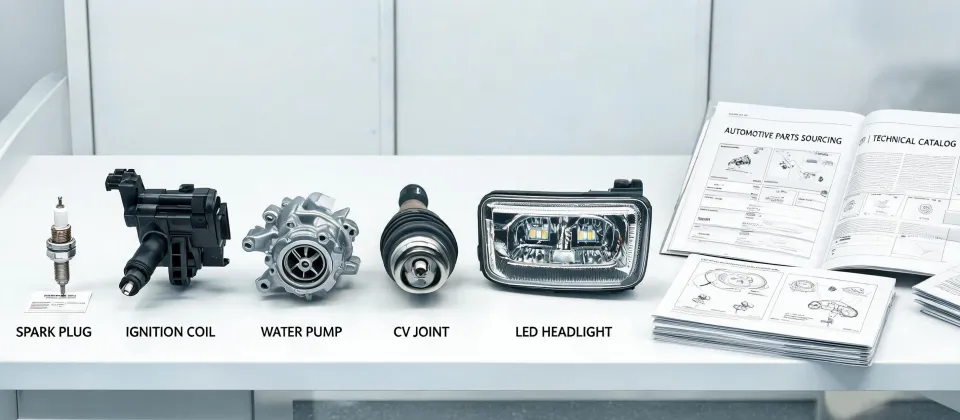
In March 2023, we needed a replacement water pump for a 6.7 Powerstroke engine. The original supplier quoted a 10-day lead time. A competitor had it in stock—5 days, at a 15% premium. My spreadsheet said choose the cheaper option. I did.
Day 6. No part. Day 8. Still no tracking update. Day 10. They finally admitted a raw material shortage. We ended up expediting from a third supplier at a 40% markup. The total cost of my 'savvy' decision? $1,200 in lost production time, $480 in premium shipping, and a very frustrated plant manager.
Here's the thing: the 'cheapest' option isn't just about the sticker price—it's about the total cost including your time spent managing issues, the risk of delays, and the potential need for redos. What I mean is that when I calculate total cost of ownership (TCO), I now factor in three things the unit price never shows: the cost of uncertainty, the cost of expediting when things go wrong, and the cost of a stopped production line.
Why Certainty Demands a Premium
In Q2 2024, when we switched vendors for a critical stamping die, I deliberately chose a supplier with a higher base quote. Why? Because they offered a guaranteed delivery window with a contractual penalty for lateness. The other vendor? 'We'll do our best.'
That 'guarantee' cost us 18% more on the unit price. But when we had a last-minute design revision (as always happens), the supplier absorbed one round of tooling changes without extra charge. The net effect? Our per-part cost was actually 3% lower than the 'cheaper' vendor's final invoice after change orders.
Look, I'm not saying budget options are always bad. I'm saying they're riskier. The premium you pay for guaranteed delivery (like those offered by reputable suppliers including Valeo—check their official site for lead times) isn't buying speed. It's buying the removal of a variable: uncertainty.
The Hidden Cost of 'Probably On Time'
Honestly, I'm not sure why some vendors consistently beat their quoted timelines while others consistently miss. My best guess is it comes down to internal buffer practices and inventory management. But I've tracked our procurement data over 48 months, and here's what I found:
- Vendors with 'estimated' delivery dates were late 34% of the time, averaging 3.2 days delay.
- Vendors with 'guaranteed' delivery dates (with contractual penalties) were late 3% of the time, averaging 0.4 days delay.
- The cost of a late part? For us, a 2-day delay on a single component costs $400-600 in line downtime. A 5-day delay? Easily $1,500+.
Add up the math, and the 'guaranteed' vendor—even at a 15-20% price premium—becomes the lower-cost option in any scenario where the part is critical to production. This worked for us, but our situation was a mid-size supplier with predictable ordering patterns. If you're a seasonal business with demand spikes, the calculus might be different.
When the Premium Doesn't Pay
I can only speak to domestic operations. If you're dealing with international logistics for something like a Dennys Driveshaft order or a custom catalytic converter cleaning tool, there are probably factors I'm not aware of. But the principle holds: in an emergency, uncertainty is your biggest cost.
Here's a specific example from our books. In early 2024, we needed a rush order for a set of automotive molds. Vendor A quoted $4,200 with standard 14-day delivery. Vendor B quoted $4,900 with 7-day guaranteed delivery. My procurement team initially flagged Vendor A. I overrode them.
Why? Because I'd just been burned (see above). We paid $4,900, the parts arrived in 6 days, and we avoided a $2,000 production delay. That $700 premium saved us $1,300. Net savings: $600. Paying more saved money.
In my first year in procurement, I made the classic rookie error: assumed 'standard' meant the same thing to every vendor. Cost me a painful lesson when we had to re-spec a critical part because the 'standard' tolerance from the low-cost vendor wasn't actually standard for the application.
The Bottom Line
I know this sounds counterintuitive to anyone raised on cost-reduction targets. It flies in the face of every procurement training that says 'lowest bidder wins.' But here's my take after tracking $180,000 in cumulative spending across six years: in an emergency, the cheapest option is the riskiest. And risk has a cost.
I've never fully understood why some procurement systems penalize paying a premium for speed while ignoring the cost of delays. If someone has insight, I'd love to hear it. But until then, I'll keep budgeting 10-15% of my annual spend for 'certainty premiums'—and sleeping better knowing the line won't stop on my watch.